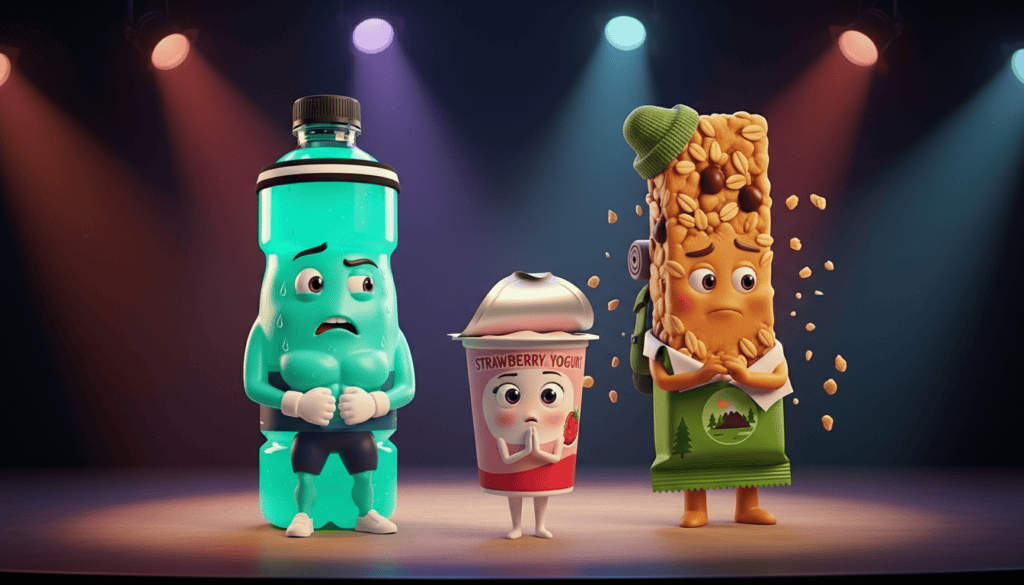
Some foods get a lifetime pass. They show up in gym bags, lunchboxes, and breakfast routines without anyone stopping to check what is actually in them. Sports drinks, flavored yogurt, and granola bars are three of the worst offenders. All three are marketed as healthy choices. All three are hiding more sugar than most people realize.
Here is what the labels do not want you to notice.
Sports drinks: made for athletes, consumed by everyone
A standard 20-ounce bottle of a popular sports drink contains about 34 grams of sugar. That is roughly 8 teaspoons in a single bottle. For context, the American Heart Association recommends women consume no more than 25 grams of added sugar per day and men no more than 36 grams. One bottle can put you at or over the daily limit before lunch.
These drinks were designed for a very specific situation: replacing electrolytes and carbohydrates during intense exercise lasting two or more hours. The sugar is there because it serves a function during prolonged physical activity. It helps muscles absorb fluid and provides quick energy when glycogen stores are depleted.
The problem is who is actually drinking them. The vast majority of sports drink consumers are not elite athletes running for two-plus hours. They are sitting at desks, driving to work, or handing bottles to kids after a 20-minute soccer practice. In those contexts, the sugar serves no athletic function whatsoever. It is just sugar.
The electrolytes are real, but they are not hard to replace. A normal meal covers your sodium and potassium needs. And unless you just ran for two hours straight, you need water. It is free.
What to drink instead
Unless you are exercising intensely for two or more hours, especially in heat, water is all you need. That is the one scenario a sports drink was built for. For everyone else, save your money and drink water.
Flavored yogurt: breakfast or dessert?
Yogurt has an almost untouchable health reputation. It has calcium, protein, probiotics. All of that is true. But most people are not eating plain yogurt. They are eating flavored yogurt, and that changes the equation dramatically.
A flavored yogurt can contain up to 30 grams of sugar per cup. That is more than seven teaspoons of added sugar in a single serving. Meanwhile, plain yogurt contains only about 4 grams of sugar per cup, and all of that is naturally occurring lactose, not added sweetener.
That means the flavored version can have more than seven times the sugar of plain. The gap is enormous, but they sit next to each other on the shelf and carry the same health halo.
The marketing makes it worse. A picture of a strawberry on the label, the word “natural,” a claim about probiotics. None of that changes what is on the nutrition label. A yogurt cup with 30 grams of sugar is delivering roughly the same sugar load as a scoop of ice cream. The probiotics are nice, but they are not doing enough to offset what is effectively a dessert.
How to fix your yogurt
Buy plain. Throw actual fruit in it. You just made a better version in ten seconds. Even if you add a teaspoon of honey yourself, you end up with far less sugar than any pre-flavored option. You get the same calcium, the same probiotics, and the same protein, without the sugar bomb.
Granola bars: candy in a hiking wrapper
Granola bars might be the most successfully marketed fake healthy food in existence. The packaging shows mountains, sunrises, whole oats, and honey. The branding screams “wholesome outdoor nutrition.” The nutrition label tells a different story.
A typical granola bar contains 15 to 25 grams of sugar per bar. Some are as much as 40 percent sugar by weight. When a chocolate bar looks at your nutrition label and cannot figure out what makes you the “healthy” option, the branding has officially outrun the product.
Look at the ingredient list and you will often find sugar listed within the first three ingredients, sometimes appearing multiple times under different names: sugar, brown sugar syrup, honey, corn syrup, fructose. When the thing holding your “health food” together is essentially sugar in various forms, the nature photo on the wrapper becomes ironic.
The real problem is how people consume them. Granola bars are treated as everyday snacks, packed into lunchboxes and eaten daily. They are the only food that gets to be 40 percent sugar and still end up in a kid’s lunchbox with a note that says “eat healthy today.”
What to look for (or avoid)
If sugar is in the first three ingredients, that is candy that does yoga. Put it back. Look for bars where nuts, seeds, or whole grains are the primary ingredients and total sugar stays well under 10 grams per serving. Better yet, grab a handful of mixed nuts. More protein, more healthy fat, more fiber, and no misleading packaging.
The pattern
Sports drinks, flavored yogurt, and granola bars all share the same playbook. They take a food category with genuine health potential, load it with sugar, wrap it in marketing that emphasizes the healthy parts, and rely on consumers never flipping the package over.
The base versions of all three can be perfectly fine. Water with electrolytes is useful during intense extended exercise. Plain yogurt is one of the best snacks you can eat. Oats and nuts are genuinely nutritious. But the versions most people actually buy and eat have been engineered for taste, not health. The health claims on the front of the package are technically true while being practically misleading.
One simple habit changes everything: check the sugar line on the nutrition label before you buy. If a “healthy” food has more sugar than you would put in your coffee, it probably is not as healthy as it wants you to think.
Watch the full episode
We broke this down in a 60-second animated short. Watch it here:
Follow us on YouTube and TikTok for new episodes every week.
Sources
- Harvard T.H. Chan School of Public Health: Added Sugar in the Diet — Overview of hidden added sugars in yogurt, granola bars, cereals, and other processed foods.
- American Heart Association: Added Sugars — Recommends no more than 25g/day for women and 36g/day for men.
- American College of Sports Medicine Position Stand: Exercise and Fluid Replacement — Carbohydrate-electrolyte drinks recommended only for exercise lasting over one hour; plain water sufficient for shorter activity. Medicine & Science in Sports & Exercise, 1996.
- Variations in Sugar Content of Flavored Milks and Yogurts: A Cross-Sectional Study across 3 Countries — Found that flavored yogurts contain significantly more sugar than plain varieties. Advances in Nutrition, 2019.
- Harvard T.H. Chan School of Public Health: Sugary Drinks — Overview of sugar-sweetened beverages and health impacts.